
Bridge Loans in Virginia

Short-term financing that bridges the gap between deals — buy before you sell, reposition, or close fast. Direct lender, LLC-friendly.

AAPL Member · Direct Lender Since 2016 · NMLS #1979189

This page was written and reviewed by Ruth Laus, who works on bridge loans at Tidal Loans daily. Terms are checked against our current underwriting guidelines; last reviewed October 2026.

In competitive markets like Northern Virginia and Richmond, the best deals are often lost to timing, not money. The property is right and the numbers work, but your capital is tied up in another property that hasn’t sold yet, or stuck behind permanent financing that won’t close for weeks. Bridge loans in Virginia solve exactly that — short-term financing that spans the gap between where your money is now and where you need it to be. Tidal Loans is a direct lender that’s financed Virginia investors since 2016, and we move at the speed the market demands.

A bridge loan is a temporary loan that gets you from point A to point B — from an offer you need to make today to the sale or permanent financing that’s still weeks or months out. It’s secured by real estate, funds quickly, and is built to be paid off as soon as your longer-term plan comes through. For Virginia investors who move fast, it’s one of the most practical tools available.

How Does a Bridge Loan Work?

A bridge loan is short-term financing secured by the property itself, used to move on a deal now and arrange permanent financing later. We underwrite the asset and your exit plan rather than your personal income, so there are no tax returns and no debt-to-income ceiling. Loan amounts run from $75,000 to $5,000,000.

A bridge loan is built around three things: the property’s value, the loan-to-value we’ll fund, and your exit. Most bridge loans fund a portion of the property’s value — how much we advance depends on the property, your experience, and the strength of your exit — with the rest coming from your equity or down payment. They’re usually interest-only during the term, which keeps your payments low while you reposition the property or wait for your sale or refinance to close, with the balance due as a balloon at the end.

The exit is the heart of the loan. Every bridge needs a clear, believable plan to be paid off — the sale of another property, a refinance into permanent financing, or a takeout loan. We underwrite that exit as carefully as we underwrite the property, because a bridge without a solid exit is just a deadline with no plan behind it. You can model the carry on a Virginia deal with our bridge loan calculator, and our full approach is covered on the bridge loan hub.

When Should a Virginia Investor Use a Bridge Loan?

Usually when timing matters more than rate: buying before an existing property sells, taking down a deal a bank will not move fast enough on, or holding a position together while a refinance is arranged. What we underwrite is the exit — how the loan gets paid off, and how realistic that plan is.

The classic use is buy before you sell — you’ve found the next Virginia property but your capital is locked in one you haven’t sold yet. A bridge loan lets you close on the new deal now and pay it back when the old property sells.

The second is value-add repositioning — you buy an underperforming property, improve it or fill vacancies, then refinance into permanent financing once it’s stabilized and worth more. This overlaps with a Virginia fix and flip loan; the difference is mostly whether your exit is a sale or a long-term hold.

The third is speed on a time-sensitive purchase — an auction, a motivated seller, or a hard closing date in a competitive Virginia market. When you can’t wait for a slow loan, a bridge gets you to the table, much like our Virginia hard money loans do for fast acquisitions.

And the fourth is multifamily and commercial transitions, carrying an apartment deal through acquisition and stabilization before permanent financing — handled alongside our Virginia multifamily lending.

Bridge Lending Across Virginia's Major Markets

We fund bridge loans across Virginia. In Northern Virginia, high values and fast-moving deals make bridge financing the way to compete with cash buyers. Richmond supports value-add bridge plays across the metro. In Hampton Roads around Norfolk and Virginia Beach, steady rental demand makes repositioning attractive. We also lend in Roanoke and Williamsburg.

Bridging to Long-Term Financing

A bridge loan gets you into a Virginia property and through the transition. A permanent loan keeps you there. Once the property is stabilized, you refinance the bridge into a long-term Virginia DSCR loan for a rental hold, or pull equity out with a cash-out refinance to fund the next deal. Plan that takeout before you close the bridge.

What Are the Terms on a Virginia Bridge Loan?

Investment property only, with loan amounts from $75,000 to $5,000,000 and a short term matched to your exit. There is no minimum credit score. We do review credit, but a lower score means a higher rate or more conservative leverage, not a decline.

Loan Details

Property TypesAll 1–4 unit residential, multifamily, and commercial properties
Loan TypesBridge, fix & flip, DSCR/rental, multifamily, cash-out refinance
MarketsRichmond, Virginia Beach, Norfolk, Alexandria, Arlington, Roanoke, and surrounding submarkets
Loan Amounts$75,000 – $5,000,000
TermTypically 6–24 months
StructureOften interest-only; balloon at term, matched to your exit

Want it run by an actual underwriter before you commit?

Virginia

Deal We Structured: Fix-to-Hold Bridge Refinance in Richmond's Washington Park

This was a 1946 brick-front bungalow on Cheatwood Avenue on Richmond's North Side: 979 square feet, three bedrooms, one bath, on a tenth-of-an-acre lot. The investor already owned it and was in the late stage of a renovation. They needed a short-term loan to finish the work and carry the house until it was ready for long-term rental financing.

The numbers: as-is value of $200,000, a remaining budget of $37,620, and an after-repair value of $275,000. We funded a $76,940 bridge loan and built an interest reserve into it, so the borrower wasn't paying out of pocket during the renovation. A title issue came up close to the finish line, and we worked it out at the closing table instead of pushing the date.

Why Washington Park works: this North Side pocket just off Brookland Park Boulevard has turned over fast. The renovation analysis showed less than half a month of inventory and a median of 13 days to sell, and close to 70% of nearby sales were already remodeled. Brand-new infill homes on this same street are listing in the $400s, which tells you where buyers think the block is going. One detail that mattered: the appraiser left out sales to the west in Bellevue. That's a separate, pricier market, and using it would have inflated the value. We'd rather size the loan off the honest comp set.

What made it a good bridge deal: a clear exit, a small remaining budget relative to value, and an investor who had already done most of the work. Bridge money is cheapest when it buys time to finish, not time to figure things out.
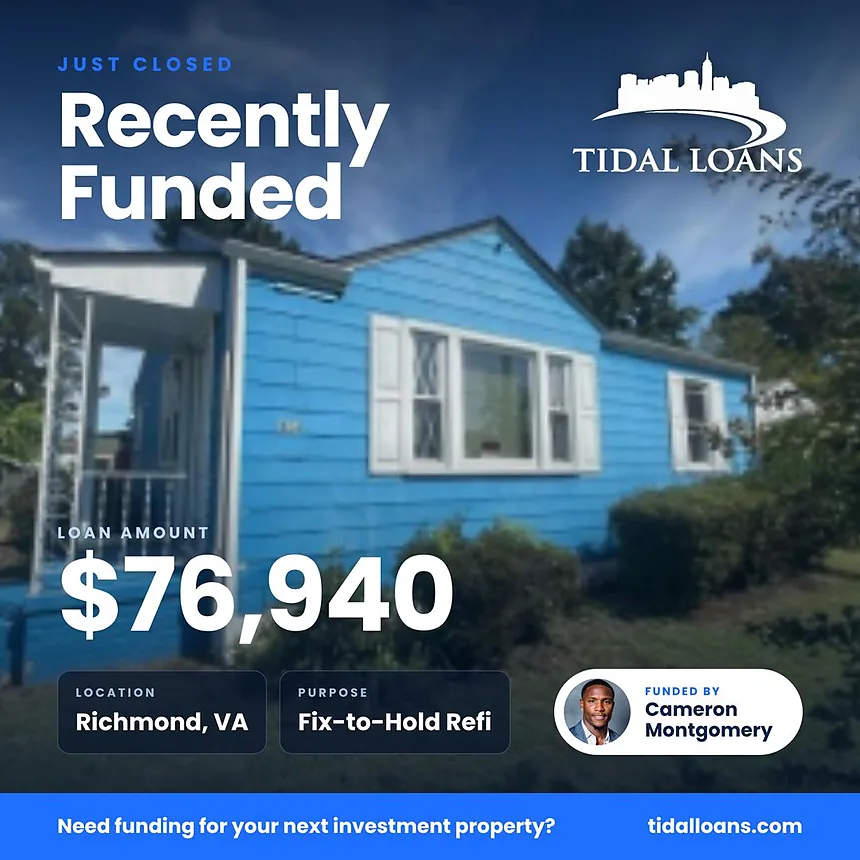
Recently funded bridge loan in Richmond's Washington Park neighborhood, Tidal Loans

Want it run by an actual underwriter before you commit?

Frequently Asked Questions

Yes — that’s one of the most common reasons investors use them. A bridge loan lets you close on a new property now using the equity in the property you haven’t sold, then pays off when that sale closes. We’ll want to see that the property you’re selling is realistically positioned to sell within the loan term, since the exit drives the whole structure.

Most are. Bridge loans are commonly structured as interest-only during the term, which keeps your monthly carry low while you reposition the property or wait for your exit to close, with the full principal due as a balloon at the end. That structure preserves your cash flow during the months you may be carrying two properties or funding renovations.

This is why the exit plan matters so much up front. If a sale or refinance runs long, options can include an extension or refinancing into another short-term or permanent loan, depending on the situation. We build in realistic timing and talk through contingencies before we fund, so a delay doesn’t catch anyone by surprise.

Yes. Bridge financing is widely used on Virginia apartment and commercial deals, often to acquire and stabilize a property before refinancing into permanent financing. For five-or-more-unit properties we handle these through our Virginia multifamily program, which uses related underwriting tailored to larger assets and their income.

We lend statewide. Northern Virginia, Richmond, and Hampton Roads are our most active markets, but we fund bridge loans in Roanoke, Williamsburg, and the surrounding areas. Wherever your Virginia deal is and whatever the timing gap, if you have a clear exit, we can structure a bridge to fit it.

Ready to fund your Virginia deal?

Get a fast quote from a direct lender — or call and walk it through with us.

Secret Link